Leandro Missiatto · visual artist
About
Biography
Leandro Missiatto
visual artist
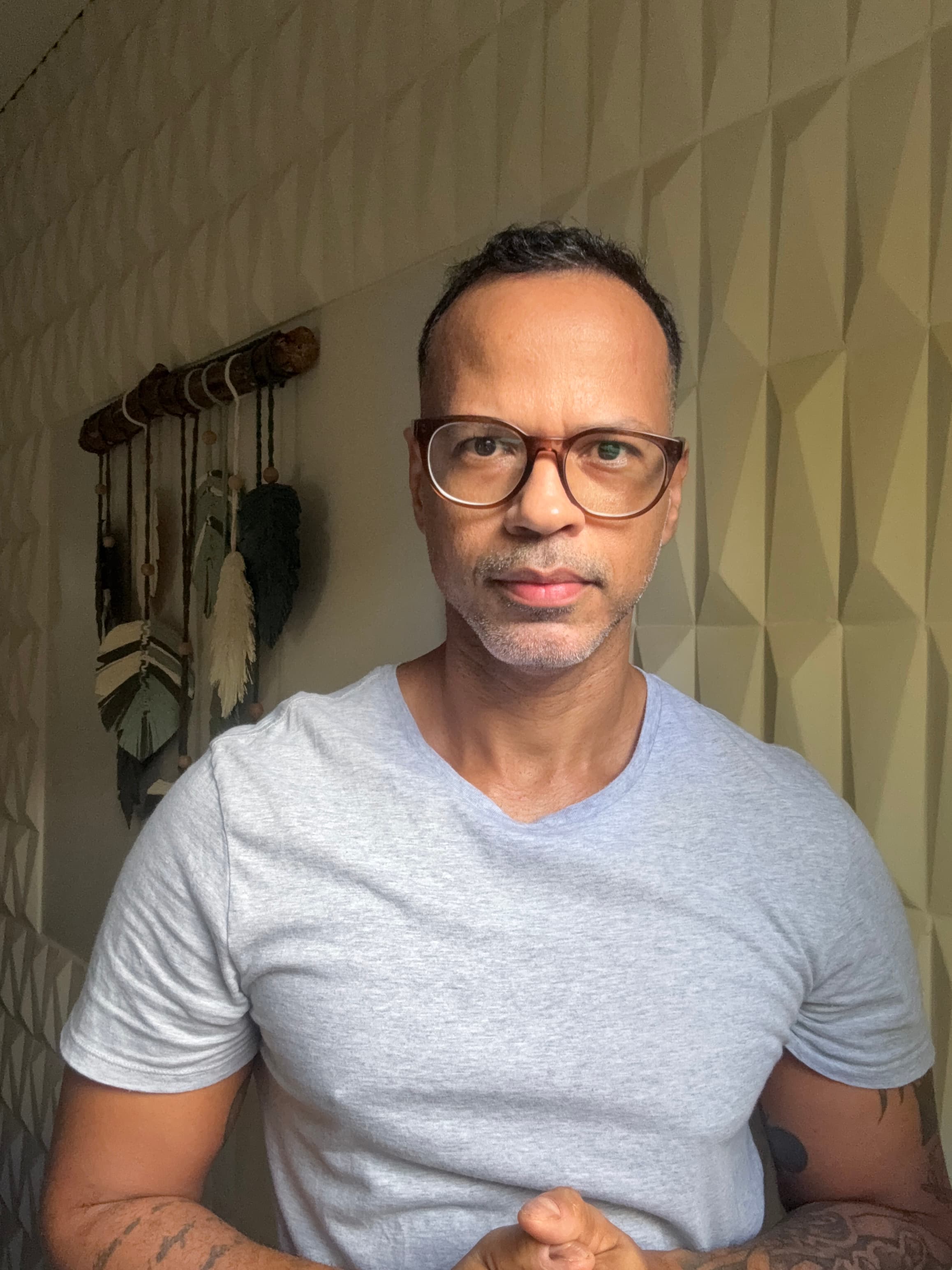
Leandro Missiatto is a Brazilian visual artist based in Pimenta Bueno, Rondônia. His work investigates relationships between body, memory, territory and the transformation of the Amazonian landscape, bringing together social experiences, displacement, environmental traces and forms of belonging. He works primarily with painting and mixed media on paper and canvas, combining acrylic, watercolor, pastel, charcoal, India ink and other materials. His research moves between figuration and abstraction, drawing on fragments of the body, cartographies, dissolutions, stains and layers to construct images in which subject and territory intersect.
01
Statement
My work begins with a recurring question about what remains inscribed in bodies and territories even after transformation. I approach the Amazon as lived experience, memory, a landscape under dispute and a field of relationships, avoiding treating it solely as a recognizable image or a repertoire of representation.
In the works, body and territory often cease to occupy separate positions. Skin, water, maps, scars, rivers, vegetation, urban traces and pictorial matter begin to share the same surface. I am especially interested in the moment when a figure begins to dissolve, a cartography crosses a body, or a landscape ceases to be merely a setting and begins to take part in the constitution of human presence itself.
The painting is built through accumulations, erasures, transparencies, scrapings, stains and overlays. I work between figuration and abstraction because this instability allows the image to remain open, without closing into a single narrative. What I seek is to work from the marks that territory produces in memory, experience and matter.
02
Artistic research
My artistic research develops from the relationships between body, territory, memory and environmental transformation in the Amazon, with particular attention to the ways changes in the landscape, displacement, social experiences and processes of belonging leave material and symbolic marks.
The human figure often appears partially, fragmented or dissolving. Rather than functioning as an isolated character, it merges with the landscape, waters, cartographies and pictorial surfaces. This choice makes it possible to think of the body as a site where territorial, historical and affective experiences are inscribed.
Cartographies appear repeatedly, though rarely as descriptive maps. They emerge as lines, paths, routes and structures crossing arms, faces, backgrounds and stains, operating more as spatial memory than as objective geographical representation.
Formally, I work between figuration and abstraction. I am interested in preserving ambiguities, zones of disappearance and areas where the image seems to be constructed and erased at the same time. I use acrylic, watercolor, dry and oil pastel, charcoal, India ink and other mixed media on paper and canvas, exploring glazes, sprays, scrapings, overlays and different densities of matter.
Experimentation is part of this path. Material tests, changes of direction and works that do not reach a definitive form also participate in the construction of the language and feed later series.